


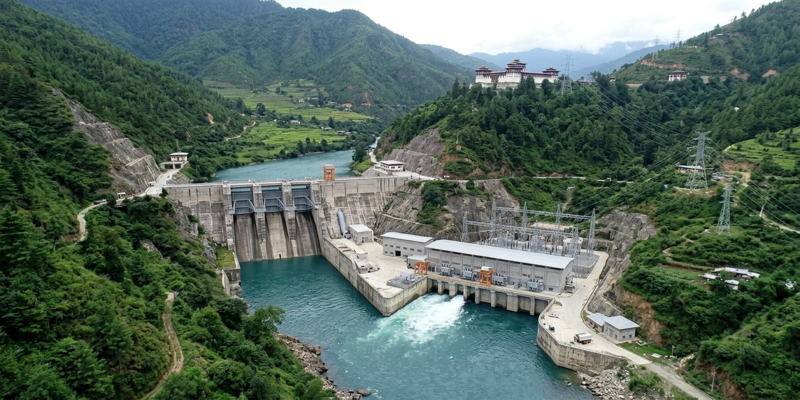
Bhutan has long been the world’s poster child for environmental stewardship, but its latest move proves that being “carbon-negative” can also be a massive economic engine. In a historic collaboration with the World Bank and India’s Tata Power, the Royal Government of Bhutan has greenlit Dorjilung Hydroelectric Power Project, a $1.7 billion initiative that promises to reshape South Asia’s energy landscape.
Table Of Content
A Financial Masterclass in Sustainability
At the heart of this project is a sophisticated Public-Private Partnership (PPP) designed to fuel growth without drowning the nation in debt. The financing structure is a strategic blend of grants, credits, and private equity:
- The Stakeholders: The Druk Green Power Corporation maintains a majority 60% stake, while Tata Power holds the remaining 40%.
- World Bank Support: A $515 million agreement was signed, including a $150 million grant and a $150 million credit from the International Development Association (IDA), alongside a $15 million enclave loan from the IBRD.
- Debt Protection: By leveraging these concessions, Bhutan has limited its direct credit exposure to just $150 million, ensuring long-term fiscal stability.
Engineering Power on the Kurichhu River
Located in the Mongar and Lhuentse districts, the Dorjilung facility is a technical marvel designed to harness the raw power of the Kurichhu River.
- Capacity: The plant boasts a 1,125 MW capacity, utilizing six massive turbines.
- Design: It operates as a “run-of-the-river” project with a six-hour pondage for peak demand management.
- Infrastructure: Beyond the dam, the project requires 30 kilometers of new roads and several bridges to navigate Bhutan’s rugged eastern terrain.
Once operational in September 2031, the plant will account for nearly one-third of Bhutan’s total energy generation, producing over 4,500 GWh annually.
Solving the Winter Crisis & Boosting Exports
For years, Bhutan has faced a seasonal paradox: a surplus of energy in the summer but severe shortages during the freezing winter months. The Dorjilung project provides a permanent fix.
- Domestic Security: The plant will completely bridge the winter energy gap, ending Bhutan’s reliance on expensive imported power.
- Export Revenue: During the monsoon season, when water levels peak, Bhutan will export 80% of its surplus electricity to India.
- Economic Reinvestment: The billions in projected revenue over the 30-year credit period are earmarked for the government’s thirteenth Five-Year Plan, with profits specifically targeted for healthcare and education.
A Regional Model for Carbon-Negative Growth
This isn’t just about electricity; it’s a blueprint for the future of developing nations. By replacing fossil fuel reliance with renewable hydropower, the project reinforces Bhutan’s status as a global leader in climate action.
The successful launch of this plant creates a scalable template for green public-private partnerships worldwide. It demonstrates that with the right international backing and private sector synergy, a small nation can achieve energy independence while fueling the regional transition toward a cleaner, more sustainable planet. As construction begins, the world watches Bhutan prove that “green” and “growth” are not mutually exclusive; they are two sides of the same coin.







No Comment! Be the first one.