


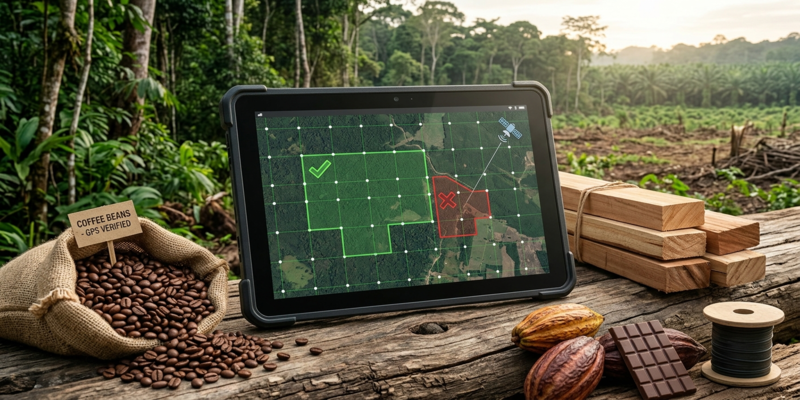
The European Commission has released a critical simplification review for the EU Deforestation Regulation (EUDR). While the core legal requirements remain unchanged, the new guidance aims to standardize enforcement across member states and reduce administrative burdens for global companies. The goal remains clear: ensuring that the products consumed by European citizens do not contribute to deforestation or forest degradation worldwide.
Table Of Content
Key Deadlines and Compliance Dates
Despite heavy industry lobbying for a delay, the Commission has maintained its strict implementation timeline.
- Enforcement Deadline: December 30, 2026.
- Physical Import Ban: January 1, 2027 (for non-compliant goods).
- Targeted Commodities: Coffee, cocoa, timber, beef, soy, palm oil, and rubber.
The Geolocation Mandate
The most significant hurdle for global supply chains is the strict data tracking requirement. Importers must provide exact GPS coordinates for the land where the raw materials were produced.
- Digital Verification: Inspectors will use satellite imagery to compare farm coordinates against historical forest maps.
- Zero Tolerance: Any land clearing detected after the cutoff date will result in an automatic rejection at European ports.
- Technological Shift: Logistics companies and small-scale farmers must adopt modern digital tools and tracking software to remain eligible for the EU market.
Critical Policy Decisions and Exceptions
| Feature | Status | Impact |
| Core Legal Text | Unchanged | No softening of environmental standards or data requirements. |
| Leather Products | Excluded (Temporary) | Frustrated activists; creates a temporary loophole for the cattle industry. |
| Administrative Burden | Reduced | New guidance streamlines paperwork for “low-risk” partner countries. |
| Small Farmers | In Transition | Potential struggle with digital paperwork; requires global education efforts. |
The review clarified several “grey areas” while also sparking debate among environmental watchdogs.
Economic and Regional Impact
The EUDR represents a massive shift in agricultural economics, particularly for South American and Southeast Asian exporters.
- South American Challenges: Brazil and neighboring nations must modernize land management immediately. Losing EU market access would be economically devastating for beef and soy producers.
- Multinational Costs: Large brands are investing millions in specialized compliance officers and software. These costs are likely to be passed on to European consumers, potentially raising the price of coffee, chocolate, and snacks.
- Reinvestment in Ethics: While prices may rise, the EU argues this is a necessary investment in global biodiversity and carbon sequestration.
Looking Ahead to 2027
The next two years will be a race against the clock for global trade organizations. The “chaotic transition” predicted by logistics experts hinges on the ability of small-scale rural farmers to provide the high-tech data required by Brussels. Successful implementation will require unprecedented levels of international cooperation to protect the world’s remaining rainforests while maintaining stable food supply chains.
How will the exclusion of leather from the current EUDR scope impact the regulation’s overall effectiveness in slowing tropical deforestation?







No Comment! Be the first one.