


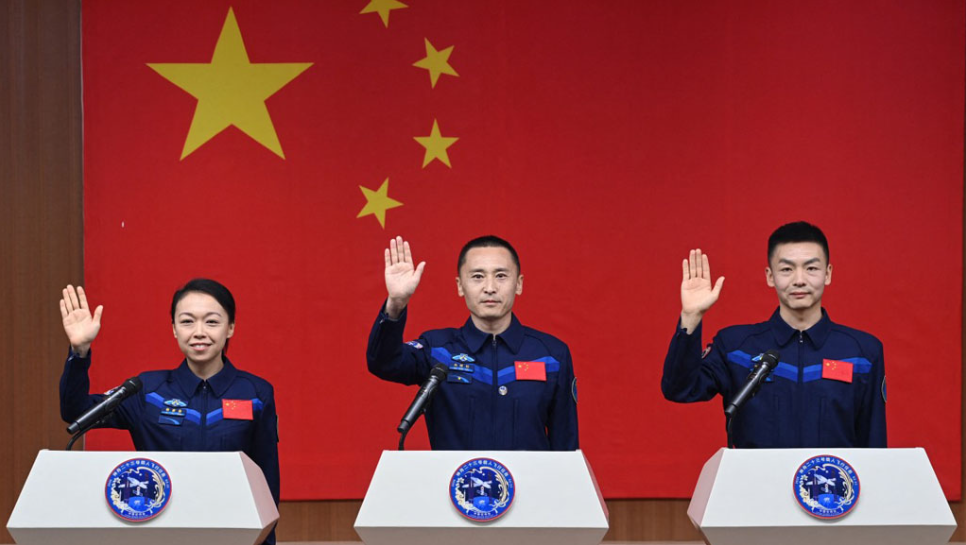
China successfully launched the Shenzhou-23 spacecraft to the Tiangong space station on Sunday. Three astronauts will conduct a historic year-long orbital experiment to prepare for future lunar landings. This mission introduces new spacecraft upgrades and opens doors for international space cooperation.
Table Of Content
The mission began late at night in the Gobi Desert. A Long March-2F rocket carried the spacecraft into orbit. The launch took place at the Jiuquan Satellite Launch Center.
The spacecraft reached its designated orbit within ten minutes. This flight marks a big step in global space exploration. One crew member will stay in orbit for an entire year. An extended stay will test human endurance in zero gravity.
Meet the Groundbreaking Crew
The China Manned Space Agency carefully selected this crew. Zhu Yangzhu commands the Shenzhou-23 mission. He previously flew on the Shenzhou-16 spaceflight.
Zhu serves as a highly skilled flight engineer. Zhang Zhiyuan joins the team as the spacecraft pilot. This mission is his first journey into space.
Zhang previously worked as an Air Force pilot. Lai Ka-ying completes the three-person crew. She serves as the dedicated payload specialist.
Lai is the first astronaut from Hong Kong to reach space. She previously worked as a superintendent in the Hong Kong Police Force. Her inclusion brings immense pride to the region.
Both Zhang and Lai come from newer astronaut training batches. This diverse team brings fresh expertise to the space station.
One-Year Experiment
The mission features a groundbreaking scientific objective. One astronaut will remain aboard Tiangong for a full year. This duration sets a new record for the Chinese space program.
Extended space travel affects the human body significantly. Scientists need data on bone density and muscle loss. The one-year stay provides vital health and psychological information.
The findings will improve life-support systems for deep space travel. Researchers will study human adaptation to long-duration spaceflight. This knowledge is necessary for future lunar missions.
China wants to land astronauts on the moon before 2030. The year-long experiment serves as a crucial stepping stone. The astronaut will maintain a strict exercise and work schedule.
The crew will also perform various space science experiments. They will conduct several challenging extravehicular activities outside the station.
Doors for Global Partners
The extended orbital stay creates a unique opportunity. It allows an international guest to visit the space station soon. A Pakistani astronaut will launch on the upcoming Shenzhou-24 mission.
This guest will spend a few days aboard Tiangong. The visitor will then return to Earth on the Shenzhou-23 spacecraft. The returning vehicle will use the seat of the year-long resident.
This seat exchange demonstrates smart logistical planning. It also highlights growing international cooperation in space. China plans to welcome more foreign astronauts in the future.
The space station is becoming a truly global research hub. This collaborative approach benefits the entire scientific community. Shared knowledge accelerates global technological progress.
Spacecraft Upgrades and Safety
Engineers implemented major upgrades for the Shenzhou-23 spacecraft. The vehicle now features enhanced window protection. Past missions encountered minor damage from tiny space debris.
The new windows can better withstand high-speed impacts. This improvement guarantees maximum safety for the crew. The spacecraft also boasts a larger cargo capacity.
It can bring over 100 kilograms of payload back to Earth. This represents almost double the increase from previous models. Scientists can now retrieve more crucial research samples.
The spacecraft also carried special living facilities for female astronauts. These custom amenities ensure a comfortable stay during long missions. Engineers optimized numerous product details for better reliability. The space agency prioritizes crew safety above all else







No Comment! Be the first one.