


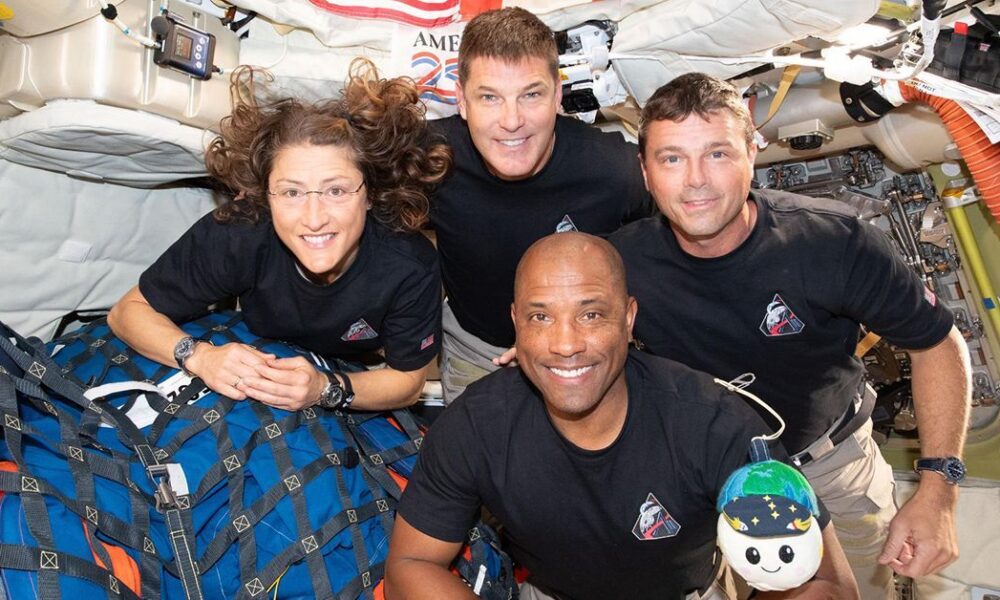
The Artemis II crew is finally home. A historic ten-day lunar mission is completed successfully. The astronauts splashed down in the Pacific Ocean on Friday. The landing occurred at exactly 8:07 p.m. Eastern Time. This flight marks a milestone for human space exploration. Aerospace industry has actionable proof of deep-space capabilities. Future lunar missions are now much closer to reality.
Table Of Content
Flawless Ocean Landing
Orion spacecraft hit the Earth’s atmosphere at extreme speeds. The capsule endured a dramatic descent. Exterior temperatures reached nearly 5,000 degrees Fahrenheit. The intense heat created a brief communication blackout, which caused blackout, a normal part of reentry.
U.S. Navy also assisted with the recovery. USS John P. Murtha secured the spacecraft. The team deployed inflatable boats quickly. Astronauts exited the capsule in excellent spirits. Medical teams checked them immediately. They soon flew to a Houston base.
Meet the Record-Breaking Crew
Four astronauts made this incredible journey. Reid Wiseman commanded the mission. Victor Glover served as the pilot. Christina Koch was a primary mission specialist. Jeremy Hansen represented the Canadian Space Agency. They are true modern pioneers.
The crew broke the record for human travel distance. They flew more than 406,000 kilometers from Earth. This feat beat the legendary Apollo 13 record. The astronauts flew around the far side of the moon.
They even saw a solar eclipse from deep space. The crew captured stunning photos of our planet. They inspired millions of people globally.
Proving New Space Technology
This mission was a vital test for new hardware. Orion capsule passed every single test. The life-support systems functioned without any flaws. The navigation tools guided the ship accurately. The propulsion engines executed precise burns.
Lockheed Martin built this incredible spacecraft. The aerospace sector sees this as a major triumph. Investors gain more confidence in commercial space ventures. The hardware is now flight-proven. Deep-space travel is a practical reality again. Engineers will study the capsule for wear and tear.
Next Era of Moon Exploration
The mission is over, but the work for the next lunar landing begins now. Artemis III is the next big step. NASA plans to put humans back on the moon’s surface. That mission is currently scheduled for 2028.
A permanent lunar base is the ultimate goal. The United States holds a strong advantage in the modern space race. Commercial partners will play a huge role. The industry expects massive economic growth. Private companies are designing lunar landers today.
Overcoming Budget Challenges
Although the technological achievements are impressive, the space program faces serious political hurdles. Lawmakers recently proposed major budget cuts for the space agency. Some political leaders want to slash funding by 23 percent. This creates uncertainty for future space missions.
The aerospace industry must navigate these financial risks carefully. Financial efficiency is more important than ever. Commercial contracts might save the broader program. Private companies offer much cheaper solutions. The overall scientific goal remains unchanged. Humanity wants a permanent presence on the moon.
The Artemis II journey is a masterclass in modern engineering. The successful return secures a bright future for space exploration. We are going back to the moon to stay. The stars are our next destination.







No Comment! Be the first one.