


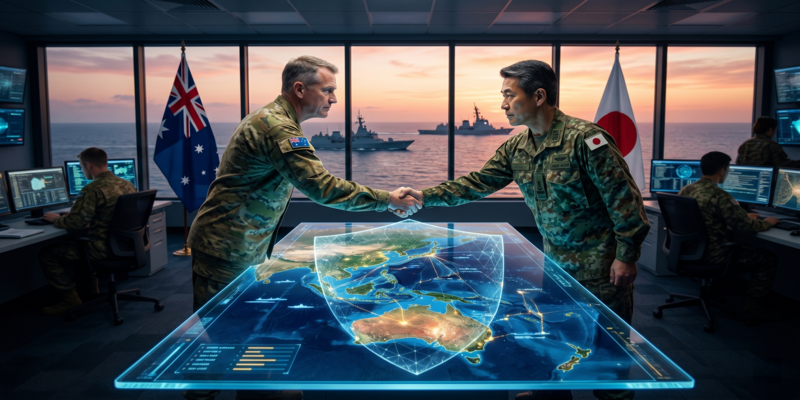
In an era where electronic warfare and digital disruption can paralyze an entire military fleet before a single shot is fired, secure communication networks have become the ultimate high ground. This reality was underscored today as military commanders from Canberra and Tokyo finalized an expansive agreement to deeply integrate their tactical network architectures. Coming directly on the heels of the highly complex Exercise Balikatan 2026, this partnership marks a monumental step forward for unified Indo-Pacific cyber defense.
Table Of Content
The primary objective of the alliance is to create an impenetrable digital shield covering allied maritime operations, focusing on the defense of highly sensitive Command, Control, Communications, and Computers (C4) infrastructure.
Hardening Allied Networks Against Advanced Persistent Threats
For years, allied operations in the Western Pacific have been plagued by sophisticated, state-sponsored cyber espionage campaigns. Advanced Persistent Threats (APTs) operating out of East Asia have consistently targeted defense contractors and military logistics nodes to map out vulnerabilities.
The newly established Indo-Pacific cyber defense framework combats this by implementing a unified “Zero Trust” architecture across all shared communications networks. Under this protocol:
- Continuous Cryptographic Authentication: Every device, satellite uplink, and tactical datalink operating within the shared Australia-Japan operational theatre must continuously re-verify its security credentials mid-mission.
- Automated Threat Hunting: The deployment of joint, AI-driven cyber defense squads that actively monitor network traffic to detect and isolate malicious code before it can move laterally into critical command systems.
- Shared Telemetry: Immediate, automated sharing of threat data, ensuring that a digital attack detected on an Australian naval asset instantly hardens Japanese air defense networks against the same vector.
The Critical Role of Interoperable Tactical Data Links
Modern combined-arms operations rely entirely on the seamless exchange of sensor data. If a Japanese destroyer detects a low-flying anti-ship cruise missile, that target telemetry must be transmitted instantly to nearby Australian or US assets to coordinate an intercept.
This level of interoperability requires deep system integration. The Australia-Japan agreement funds the alignment of their respective military information and communications technology (ICT) priorities. By utilizing identical data encoding standards and resilient software-defined radios, the two nations are ensuring that their forces can operate as a single, cohesive unit even in heavily jammed, contested electronic environments.
Setting a New Precedent for Regional Alliances
This digital integration signals a profound evolution in how international military alliances are formed. Historically, treaties focused purely on physical troop movements, hardware sales, and shared bases. In 2026, true strategic alignment requires sharing the underlying source code of national defense. As Australia and Japan lead the charge, security analysts expect neighboring partners like the Philippines and South Korea to eventually seek integration into this expanding digital framework, fundamentally altering the security balance of the Indo-Pacific.




No Comment! Be the first one.