

University of Queensland Unveils Breakthrough Tech to Turn Captured CO₂ into Industrial Chemicals

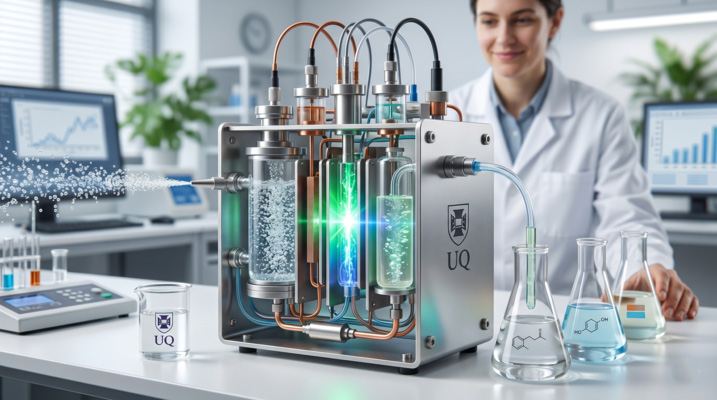
In a massive leap forward for green manufacturing and carbon capture technology, researchers at the University of Queensland (UQ) announced today the successful development of a new electrochemical generator capable of transforming captured carbon dioxide (CO₂) into highly valuable industrial chemicals.
From Waste Emission to Valuable Resource Designed by Professor Xiwang Zhang, Dr. Mike Tebyetekerwa, and PhD student Rizal Evans from UQ’s School of Chemical Engineering, the first-of-its-kind generator utilizes only three inputs: captured CO₂, water, and electricity. The process completely bypasses the need for fossil-fuel-based chemical manufacturing.
How the Electrochemical Process Works The UQ generator specifically targets the creation of formate, the base compound required to produce formic acid. Formic acid is an essential industrial chemical used extensively in agriculture (as a preservative and antibacterial agent), textile dyeing, and pharmaceutical manufacturing.
The core benefits of this new technology include:
- Decarbonizing Heavy Industry: It provides high-emissions sectors with a viable, profitable pathway to utilize their waste CO₂ rather than releasing it into the atmosphere.
- Fossil Fuel Independence: By relying solely on electricity and water to drive the chemical conversion, the system can be powered entirely by renewable energy sources like solar or wind.
- Scalability: The researchers emphasize that the generator’s modular design allows it to be integrated directly into existing manufacturing plants, capturing emissions at the source.
As global governments implement stricter carbon pricing and net-zero mandates, UQ’s breakthrough offers a critical technological bridge. It proves that carbon capture can be economically advantageous by generating immediate chemical commodities, moving the industry closer to a truly circular green economy.







No Comment! Be the first one.