

Diplomatic Loophole: How a Simple Name Change Allowed Secretary of State Marco Rubio into China Today

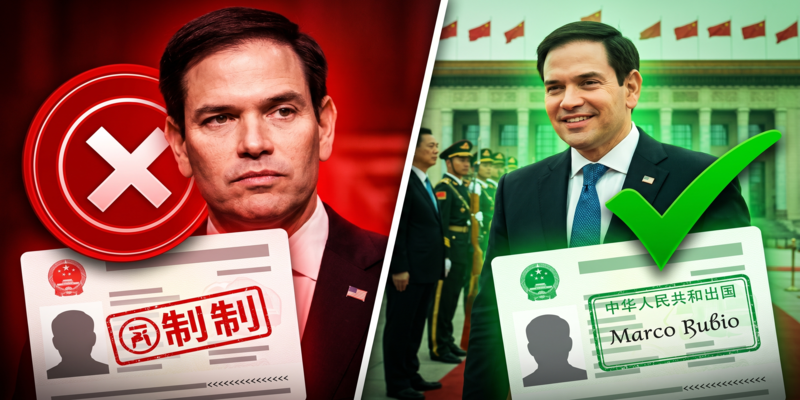
As US President Donald Trump and Chinese President Xi Jinping sit down in Beijing today for one of the most consequential summits of 2026, the presence of one American official is turning heads: US Secretary of State Marco Rubio. For years, Rubio has been a fiercely vocal critic of China’s human rights record. Consequently, he has been heavily sanctioned by the Chinese government, complete with a strict entry ban.
Table Of Content
So, how exactly is a sanctioned US official currently walking the halls of power in Beijing? The answer lies in a fascinating, face-saving linguistic workaround.
The Backstory of the Ban
During his long tenure as a US Senator from Florida, Marco Rubio championed numerous human rights initiatives that directly challenged Beijing. From advocating for the Uyghur population in Xinjiang to supporting pro-democracy activists in Hong Kong, Rubio’s legislative actions made him a primary target for Chinese retaliation. Adopting a tactic frequently used by Washington, Beijing sanctioned Rubio twice, making it legally impossible for him to secure a visa or conduct official business within Chinese borders.
When President Trump appointed Rubio as his Secretary of State following his 2024 election victory, a massive diplomatic hurdle immediately presented itself. How could the top US diplomat engage with America’s biggest geopolitical rival if he wasn’t legally allowed in the country?
The Linguistic Workaround
The solution, it turns out, was quietly implemented by the Chinese government earlier this year. The Chinese language relies on transliteration to adapt foreign names, matching Western syllables to Chinese characters. Shortly before Rubio took office in January 2025, Chinese state media and official government documents suddenly began using a different Chinese character for “lu” the first syllable used to represent Rubio’s surname.
Two diplomats, speaking to the AFP news agency under the condition of anonymity, confirmed the strategy: the sanctions and the entry ban were tied strictly to the old spelling of his name. By changing the character, the Chinese government created a new bureaucratic entity, effectively wiping the slate clean for Secretary Rubio without having to publicly backtrack on the sanctions placed upon Senator Rubio.
Chinese embassy spokesperson Liu Pengyu defended the decision on Tuesday, stating, “The sanctions target Mr. Rubio’s words and deeds when he served as a US senator concerning China.” Meanwhile, China’s foreign ministry spokesperson Mao Ning downplayed the shift, noting last year that a western official’s English name is ultimately what matters most.
The Stakes of the Summit
With the paperwork sorted, the real work begins today. The agenda for the Trump-Xi summit is overflowing with explosive issues. At the top of the list is the ongoing, delicate trade truce. Just yesterday, the US and China agreed to roll back some of the most punishing, triple-digit tariffs a move that literally saved hundreds of US-reliant factories in China from overnight collapse.
Furthermore, the global landscape is increasingly volatile. The ongoing conflict involving Iran has destabilized global markets, and Washington is desperately seeking Beijing’s influence to secure the Strait of Hormuz. Add in the ever-present tensions over Taiwan and the fentanyl crisis, and Secretary Rubio certainly has his work cut out for him.
The Human Element of Diplomacy
This situation highlights the deeply human, sometimes absurd nature of international relations. Beneath the grand pageantry, the military posturing, and the trillion-dollar trade deals, diplomacy often boils down to finding a way for everyone to save face.
By changing a single syllable on a piece of paper, Beijing preserved its tough stance on human rights critics while simultaneously ensuring that the vital lines of communication between the world’s two superpowers remain open. As the summit unfolds over the next 48 hours, the world will be watching to see if this clever linguistic loophole can translate into tangible global stability.





No Comment! Be the first one.