


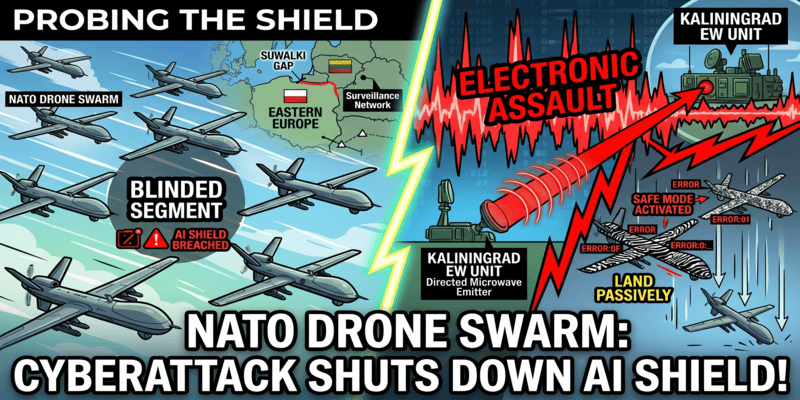
The digital perimeter of Eastern Europe has been breached. Early this morning, allied military intelligence confirmed a highly coordinated NATO drone swarm cyberattack targeting the newly deployed autonomous surveillance network guarding the Suwałki Gap.
While no physical shots were fired, the electronic assault effectively blinded a massive segment of the AI-driven border wall for nearly forty minutes, exposing a terrifying vulnerability in the alliance’s next-generation defense strategy.
The Mechanics of the Electronic Assault
The NATO drone swarm cyberattack was not a traditional brute-force hack. Instead, Russian electronic warfare (EW) units stationed in Kaliningrad utilized directed microwave emitters to scramble the swarm’s localized communication arrays.
By feeding the drones contradictory spatial data, the cyberattack forced the autonomous units into a defensive “safe mode,” causing them to drop out of the sky and land passively on the Polish border. During this 40-minute blackout window, NATO commanders were left completely blind to potential ground movements.
The Strategic Ramifications
The success of the NATO drone swarm cyberattack proves that relying solely on autonomous tech is a massive strategic risk.
- Rethinking AI Reliance: European defense contractors are now scrambling to retrofit the drones with heavily shielded, quantum-encrypted communication modules.
- Escalation Tactics: Military analysts believe this event was a “dry run.” By mapping exactly how long it takes NATO to reboot the swarm, adversarial forces now possess the exact timetable required to move a covert armored column across the border undetected in a future conflict.






No Comment! Be the first one.