


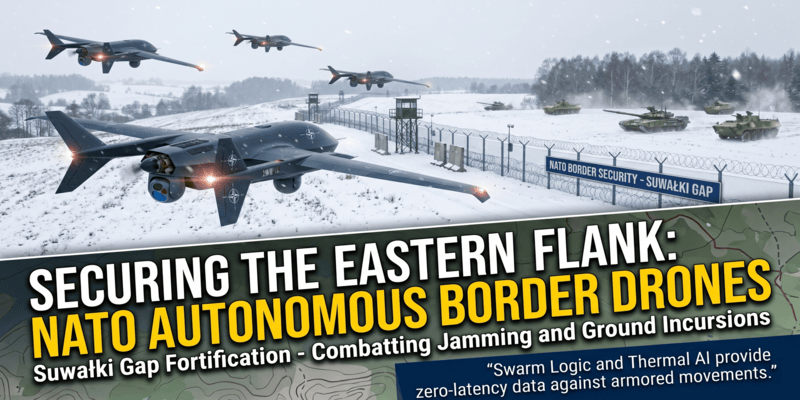
In a massive escalation of European security protocols, military commanders have officially greenlit the deployment of advanced NATO autonomous border drones. These AI-driven surveillance networks are currently being positioned along the Suwałki Gap the highly vulnerable, 40-mile stretch of land connecting Poland and Lithuania.
Why is the Suwałki Gap Being Fortified Now?
Following the recent approval of the $105 billion EU loan to Ukraine, Russian military posturing in neighboring Belarus has intensified dramatically. The Suwałki Gap is the only land connection between the Baltic states and the rest of NATO. If this corridor were severed, Estonia, Latvia, and Lithuania would be geographically isolated.
What Capabilities Do These Drones Have?
The newly deployed NATO autonomous border drones operate entirely differently from traditional, pilot-controlled aircraft.
| System Capability | Tactical Advantage | Strategic Impact |
| Swarm Logic | Drones communicate locally without relying on vulnerable satellite uplinks. | Highly resistant to Russian electronic warfare (EW) and signal jamming. |
| Thermal AI Targeting | Instantly differentiates between civilian vehicles and armored columns. | Provides generals with zero-latency, real-time troop movement data. |
By utilizing NATO autonomous border drones, European forces maintain a 24/7, unblinking eye over the most contested border in the world, ensuring no sudden armored incursions can catch the alliance by surprise.





No Comment! Be the first one.