


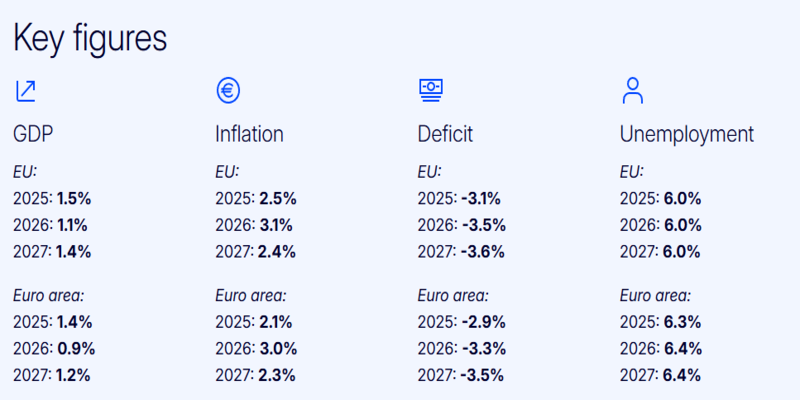
As we close out the third week of May 2026, global financial markets are reacting to the newly released Spring 2026 Economic Forecast, which highlights a notable slowdown in GDP growth paired with rebounding inflation rates. Driven largely by sustained conflict in the Middle East and resulting energy market volatility, macroeconomic indicators have shifted significantly over the past month.
Surging Energy Prices and Inflation Ticks
According to the latest May economic updates, both the U.S. and the Eurozone are experiencing a noticeable uptick in inflation.
- Eurozone Impact: Inflation accelerated from 2.6% to 3.0% over the last month, primarily driven by a dramatic jump in energy costs. However, core inflation saw a minor decrease to 2.2% as services inflation cooled.
- U.S. Impact: U.S. headline inflation surged from 3.3% to 3.8%. A sharp rise in both energy prices and shelter costs has forced economists to upgrade their U.S. inflation forecasts to 3.6% for the remainder of 2026.
GDP Growth and Central Bank Actions
Despite the inflation hurdles, the U.S. economy remains somewhat resilient, having grown by an annualized rate of 2.0% in Q1 2026, rebounding from a sluggish end to 2025. In Europe, growth remains highly fragmented; Spain and Germany performed solidly, while the French economy stagnated.
Looking ahead, both the Federal Reserve and the European Central Bank (ECB) have kept benchmark interest rates unchanged. Central banks are currently attempting to “look through” the immediate energy shock, though sustained high oil prices—currently hovering around $110 per barrel—remain the most significant downside risk to global economic stability in 2026.






No Comment! Be the first one.