


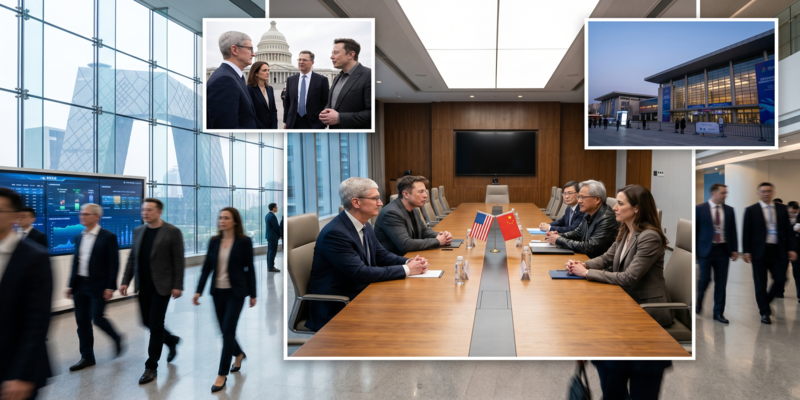
While political shockwaves hit the American South, an unprecedented concentration of corporate power descended on Beijing. A delegation of 17 prominent US technology and finance executives traveled to China this week to participate in high-stakes diplomatic and trade talks alongside the US administration.
The powerhouse roster of business leaders includes Apple CEO Tim Cook, Tesla and SpaceX CEO Elon Musk, Meta President Dina Powell McCormick, and Nvidia CEO Jensen Huang, who joined the trip late after being picked up en route. Executives from telecom giant Cisco, memory maker Micron, and semiconductor producer Qualcomm were also in attendance.
AI Regulations, Semiconductors, and Market Access
Unlike previous diplomatic trips that focused heavily on massive transactional deals, analysts view this 2026 Beijing summit as a critical effort to establish a stable “floor” for US-China relations. The massive presence of these tech titans underscores the critical importance of the Chinese consumer market and supply chain, even amidst rising geopolitical tensions and fierce, global competition over artificial intelligence dominance.
A central point of friction remains the strict regulation and export of advanced technology. Nvidia’s Jensen Huang is closely navigating the regulatory environment, as the US continues to tightly control the export of highly capable AI chips like Nvidia’s H200 to Chinese firms. The US administration is attempting to balance the aggressive promotion of American technological innovation with deep national security concerns.
The Future of the US-China Tech Corridor
For executives like Tim Cook, whose newly released Apple iPhone 17 has seen record-breaking success in the Chinese market, maintaining positive diplomatic ties is essential for sustaining robust manufacturing and sales operations. While the summit produced limited immediate breakthroughs on major tech agreements aside from a pending Boeing aircraft purchase the face-to-face culinary diplomacy and red-carpet treatment signify a mutual desire from both nations to prevent uncontrolled economic escalation.
As the global race for AI supremacy accelerates, and the US implements mandatory reviews through the Center for AI Standards and Innovation (CAISI), the delicate dance between American corporate expansion and US-China foreign policy will only grow more complex.




No Comment! Be the first one.